
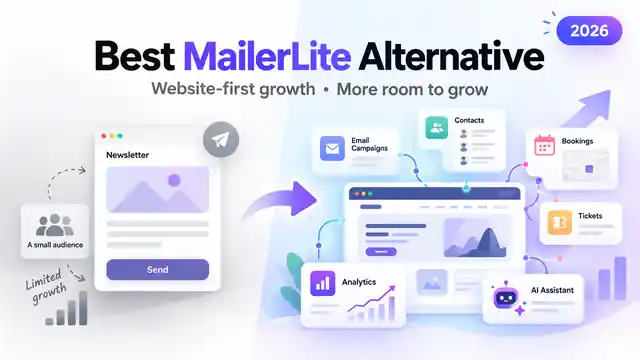
Best MailerLite Alternative in 2026: When Unlimited Contacts and Website-First Growth Matter More
MailerLite is a good email marketing product.
That is important to say upfront, because the internet is full of “alternative” pages that pretend the competitor is terrible just to sell you something else.
MailerLite has earned its reputation by being relatively easy to use, giving small teams a clean email editor, providing automations without enterprise-level complexity, and bundling landing pages, forms and websites into the same product. For a business that mainly needs email marketing, it can still be a sensible choice.
But the product changed materially in 2026.
MailerLite’s Free plan now supports up to 250 active subscribers and 2,500 emails per month. Free accounts can keep up to three active automations, three forms, one landing page, one small website and one digital product. If a free account exceeds the active-subscriber limit, campaigns and automations are paused and subscriber additions through manual imports, the API and integrations can also stop until the account upgrades or moves back under the limit.
That changes the decision for a growing website.
If you only want a clean email tool and expect to stay small for a while, MailerLite may still be enough.
If you want your website to capture leads, store a growing audience, run email and other channels, connect bookings or events, test conversion ideas and use AI to help operate the system, you may need something structurally different.
That is where Visisto fits.
This guide compares MailerLite and Visisto from the perspective of a website business in 2026. Not just feature by feature, but by operating model: what happens when traffic grows, contacts grow, campaigns multiply, and marketing stops being “send a newsletter” and becomes a connected customer journey.
The short version
Choose MailerLite if your main requirement is straightforward email marketing, newsletters, landing pages and forms, and you prefer a mature email-first product.
Choose Visisto if your website is the centre of your growth system and you want lead capture, email, automations, broadcasts, experiments, bookings, event tickets and Visi AI to work from the same customer context.
MailerLite’s plans are tied to active subscriber tiers. For the Free-plan comparison, Visisto uses a much higher active-contact allowance and a larger monthly email allowance, while its paid plans are structured around broader operating capacity rather than MailerLite-style subscriber tiers.
For businesses that expect their list to grow, that difference becomes more important every month.
What changed with MailerLite in 2026?
MailerLite updated both its Free and paid plan structure in June 2026.
The Free plan was reduced from 500 to 250 active subscribers and from 12,000 to 2,500 monthly email sends. At the same time, MailerLite opened access to additional design and publishing features such as custom templates, blogs, promotional popups and the HTML campaign editor.
The company also renamed its paid plans.
What used to be Growing Business is now Comfort.
What used to be Advanced is now Power.
That is not just a naming change. The new structure makes MailerLite’s model clearer:
- Free is for very small lists.
- Comfort scales by subscriber tier and includes a monthly sending allowance equal to 10 times the top of the subscriber tier.
- Power offers broader feature capacity and unlimited email sending subject to fair use.
- Enterprise covers larger lists and custom requirements.
MailerLite still gives users useful capabilities. The question is whether that model matches the way your business grows.
The first decision: are you buying an email tool or a website growth system?
This is the biggest distinction between the two products.
MailerLite is fundamentally an email marketing platform with adjacent tools.
Visisto is built as a website growth system where lead capture, contacts, campaigns, automations, conversion tools and AI share one operating layer.
That difference changes what the products optimise for.
With MailerLite, a typical workflow is:
Create form → collect subscriber → add to group → send campaign → run automation
That is a good workflow if email is the centre of the system.
With Visisto, the workflow can begin earlier:
Visitor arrives → targeted widget appears → contact is captured → source and context are stored → automation starts → broadcast or follow-up continues → booking, ticket or other conversion happens → activity stays on the contact → experiment or AI insight informs the next action
Email is still important.
It simply is not the only thing happening.
If your marketing stack already contains a popup tool, scheduling tool, event platform, CRM, email platform and automation connector, comparing MailerLite and Visisto purely on email features misses the bigger cost.
MailerLite Free vs Visisto Free
The difference is easiest to see on the free plans.
As of October 2026, MailerLite Free allows:
- Up to 250 active subscribers
- Up to 2,500 emails every 30 days
- Three active automations
- Three forms
- One landing page
- One website with up to five pages
- One digital product
- Two users
MailerLite’s free plan also includes useful design capabilities that make it attractive for early-stage creators and small businesses.
Visisto Free currently starts with:
- Up to 15,000 active contacts per month
- 15,000 emails per month
- Access to all 20 website widget types
- Website capture
- Follow-up automation
- A broadcast
- Contact profiles and tagging
- A custom sending domain
- Experiments and conversion features
- Limited Visi usage
- No credit card requirement
- No time limit
The exact active-feature capacity differs by plan, but the strategic difference is obvious:
MailerLite Free supports 250 active subscribers. Visisto Free supports up to 15,000 active contacts per month.
That matters even if you are not emailing everyone every week.
A contact database is an asset.
If thousands of people have given you permission to hear from your business, the software model around storing and activating those people becomes strategically important.
Why contact capacity changes the economics
Subscriber-tier pricing sounds reasonable when your list is tiny.
It becomes more noticeable once growth starts working.
Imagine you run a content site and capture 1,000 new subscribers every month.
You may actively email only a portion of the database in any given campaign. Some subscribers are recent. Some bought something months ago. Some are event attendees. Some only joined for a specific resource.
But the historical contact still has value.
You may want to:
- Re-engage them later
- Segment by source
- Invite past buyers to an event
- Announce a new product
- Build a lookalike audience
- Analyse conversion behaviour
- Exclude previous buyers from a promotion
- Trigger a campaign based on a new event
A pricing model based on active subscribers makes database growth part of the billing equation.
Visisto’s model gives the Free plan substantially more room before active-contact capacity becomes the immediate constraint, while paid plans are designed around broader operating capacity such as sending, automation and multi-site usage.
For a founder, agency, ecommerce brand or publisher trying to grow an owned audience, that is a meaningful distinction.
What happens when you exceed MailerLite Free?
This is one of the most important details in MailerLite’s 2026 plan update.
If a Free account goes above 250 active subscribers, MailerLite says campaign sending, automations and subscriber additions can be paused until the account upgrades or the active subscriber count returns below the limit.
That means growth can create an operational decision almost immediately.
At 251 active subscribers, the question is no longer only “Do I like MailerLite?”
It becomes:
Do I start paying now, or do I reduce the active audience?
That may be completely reasonable for your business. Software companies need sustainable free plans.
But it is different from Visisto’s model.
With Visisto Free, the canonical allowance is up to 15,000 active contacts per month. If you reach the monthly email sending allowance, sending can pause until the next cycle or you upgrade for more capacity, while the website capture workflow is designed to keep lead generation connected to the rest of the system.
For a growing website, capture continuity matters.
Traffic does not stop because your software plan reached a subscriber tier.
Email sending: list size versus workload
MailerLite’s paid Comfort plan uses subscriber tiers.
The monthly email allowance is ten times the ceiling of your subscriber tier. For example, MailerLite’s own documentation explains that a 5,000-subscriber Comfort tier includes up to 50,000 emails per month.
If your active subscriber count grows past the tier, the account can move to a higher pricing tier.
MailerLite also says monthly plans can automatically upgrade when subscriber or email limits are exceeded.
This creates a fairly traditional email-marketing relationship:
more subscribers → higher tier → higher cost
Visisto works differently.
The current Free plan includes 15,000 monthly emails.
Growth is £49 per month and includes 150,000 monthly emails plus the broader growth stack.
Agency is £199 per month and includes 2.5 million monthly emails for teams managing multiple websites.
The paid model is not framed around the same 250-subscriber Free ceiling. This makes forecasting easier when your audience and marketing workload grow at different rates.
Capture is where the comparison becomes less obvious
MailerLite absolutely has forms and promotional popups.
So the question is not “Does MailerLite capture leads?”
It does.
The better question is how much of your website conversion strategy do you want inside the same product?
Visisto currently provides 20 widget types built around website conversion use cases.
These can include experiences such as:
- Popups
- Spin wheels
- Scratch cards
- Inline capture
- Sticky bars
- Exit-intent campaigns
- Quizzes and finders
- Survey-style interactions
- Other targeted website widgets
This is broader than treating capture as a form placed on a page.
For an ecommerce store, the difference might be a gamified offer rather than a static signup form.
For a SaaS company, it could be a targeted message based on the page someone is viewing.
For an event business, the conversion action may be a booking or ticket rather than a newsletter subscription.
The advantage of keeping those actions inside the same system is not merely convenience.
It is context.
The platform can know what the person did before the follow-up begins.
Why context matters more than another automation step
Marketing automation is often discussed as a flowchart problem.
Trigger.
Delay.
Email.
Condition.
Email.
That is useful, but it is not the hardest part.
The hardest part is knowing enough about the customer to send the right thing.
A subscriber who joined through a discount wheel is different from a subscriber who booked a consultation.
A ticket buyer is different from someone who downloaded a guide.
A visitor who answered a product-finder question is different from a generic newsletter signup.
When capture and follow-up are separate products, you depend on integrations to move that context across.
Sometimes the integration moves everything.
Sometimes it only moves the email address.
Sometimes a custom field is missing.
Sometimes a webhook breaks.
Sometimes the automation continues running with incomplete data and nobody notices.
A connected system reduces those handoffs.
That is one of the main reasons to consider Visisto over a traditional email-first stack.
Automations: MailerLite is strong here
This is one area where MailerLite deserves credit.
MailerLite has a mature visual automation builder and is a good choice for users who want established newsletter and lifecycle-email workflows without enterprise complexity.
The current Free plan allows up to three active automations.
Comfort supports up to 50 active automations.
Power offers unlimited feature use.
For email-first businesses, that is a strong offering.
Visisto also includes follow-up automations and AI-assisted structured automation generation.
The product direction is different, though.
Visisto is trying to connect automation to the rest of the website growth loop: widgets, broadcasts, contacts, bookings, tickets, experiments and Visi.
So if your requirement is simply “I want to build sophisticated email flows,” MailerLite should remain on your shortlist.
If your requirement is “I want the conversion event and the follow-up flow to live in the same operating system,” Visisto becomes more interesting.
Visi is not just an AI writing button
Almost every marketing platform now has an AI button.
Generate subject line.
Rewrite paragraph.
Make this more friendly.
Those tools are useful, but they are becoming table stakes.
Visi is designed around a different idea: AI with access to the operational context inside Visisto.
That can include the state of website widgets, broadcasts, automations, contacts, experiments, brand information and other supported account context.
For supported website campaign actions, Visi can help create a draft, update content or design, and prepare changes that can be approved before going live.
That approval layer matters.
The point is not to let an autonomous agent make random changes to your customer journey.
The point is to let the AI understand what is already happening and shorten the path from opportunity to execution.
A generic AI assistant can tell you:
“Try an exit-intent popup.”
An AI connected to the marketing system can work toward:
“Your pricing-page traffic is high but capture is weak. Here is a draft campaign for that page, using your existing brand context, ready for approval.”
That is a different product category.
Broadcasts beyond email
MailerLite is an email-first platform.
Visisto’s broadcast layer is designed around multiple channels from the same contact system, including:
- Telegram
- SMS
That does not mean every business should suddenly message customers on four channels.
It means you do not necessarily need four disconnected customer databases when your communication strategy expands.
A creator might stay almost entirely on email.
An ecommerce store may use email plus SMS.
An event organiser may use email for nurture and WhatsApp for time-sensitive attendee communication.
A community business may value Telegram.
The customer is still the same person.
The platform should not treat them as four separate identities simply because the delivery channel changed.
Bookings are not an email feature, but they affect email
A service business often starts with this stack:
- MailerLite for email
- Calendly for scheduling
- A form or popup product for lead capture
- Zapier or Make between them
Nothing is inherently wrong with that setup.
But now a booking is happening outside your email platform.
You need the right data to move back into your marketing system if you want to:
- Stop sending a “book a call” campaign after someone already booked
- Send appointment reminders
- Send preparation content
- Trigger a follow-up after the meeting
- Segment people who booked but did not buy
- Ask for a testimonial later
Visisto includes bookings as part of the broader customer journey.
That is valuable because the booking is not merely a calendar event.
It is a marketing event.
Event tickets create the same problem
Ticketing is another category most email tools do not try to own.
If you run workshops, conferences, classes, paid meetups or other events, the customer journey may look like:
Visitor → ticket page → purchase → confirmation → reminder → event → follow-up → next event
When ticketing lives in a separate product, you usually have to sync attendees into your email platform.
Again, the problem is not that the integration is impossible.
The problem is operational fragmentation.
Visisto includes event ticketing, attendee workflows, reminders and related customer context inside the same broader system.
For businesses where events are an important acquisition or revenue channel, that can eliminate an entire category of software.
A/B testing should connect to the customer journey
MailerLite includes testing capabilities within its email and landing-page ecosystem.
Visisto extends experimentation across the website growth system.
The important idea is not simply “both products have A/B testing.”
The important question is what can be tested and what happens to the result.
If you test a website capture experience, the winning variation should affect how future visitors enter the journey.
If you test an email subject line, the result should inform future campaign decisions.
If you test an automation path, the measurement should reflect downstream conversion, not only an open rate.
Visisto’s product direction brings widgets, email, automation and broader experiments into the same environment.
That makes experimentation less isolated.
Where MailerLite is genuinely the better choice
A useful comparison should tell you when not to buy the product being promoted.
MailerLite may be the better choice if several of these are true:
You mainly need newsletters
If your marketing operation is fundamentally a newsletter and a few automations, MailerLite is focused, mature and easy to understand.
You may not need a broader website growth system.
You value landing pages and lightweight websites
MailerLite has invested in landing pages, websites, blogs and digital-product tooling.
If those content-publishing features are central to your workflow, evaluate them carefully because they may be more relevant to you than Visisto’s broader conversion stack.
Your list is small and predictable
If you expect to stay below a few hundred subscribers for a long time, the new Free plan may still be perfectly adequate.
The 250-active-subscriber ceiling only matters when you reach it.
You already have the rest of your stack
If your booking system, CRM, popup tooling and event platform are deeply embedded and working well, replacing them may create more migration work than value.
Sometimes the correct answer is to keep the stack that already works.
You want an email-first mental model
Some teams simply prefer a product where everything revolves around campaigns, subscribers, forms and automations.
There is value in focus.
Where Visisto is the better fit
Visisto becomes stronger when the problem is bigger than email.
Your list is growing and you are hitting active-subscriber ceilings
MailerLite Free supports 250 active subscribers. Visisto Free supports up to 15,000 active contacts per month.
That gives a growing website much more room before contact capacity becomes the first upgrade trigger.
Your website is the main acquisition channel
If most customers start by visiting your website, a platform that controls the capture layer has more context from the beginning.
You are paying for multiple adjacent tools
If you already pay for a popup product, email platform, scheduler, ticket platform, automation connector or testing tool, consolidating matters more than finding the cheapest email plan.
You want multi-channel communication
Email, WhatsApp, Telegram and SMS can operate from the same contact system.
You want bookings or event activity connected to marketing
Those are not separate back-office events. They are signals in the customer journey.
You want AI inside the operating system
Visi’s strategic value is the ability to work with platform context and supported actions, not just generate copy in an empty chat box.
Example: a coaching business
Imagine you run a coaching business.
Your current stack is:
- MailerLite for email
- Calendly for calls
- A popup tool for lead capture
- Typeform for a qualification form
- Zapier to connect everything
A visitor downloads a guide.
They enter MailerLite.
Later, they book a consultation.
Calendly knows about the booking.
Zapier passes some data into MailerLite.
After the call, you manually decide whether to send a follow-up.
This setup can work.
But the customer exists across multiple tools.
With a website-first system, the flow can be designed as one journey:
- Visitor responds to a website capture experience.
- Contact is created with the original acquisition context.
- Follow-up begins.
- Visitor books.
- Booking attaches to the same customer journey.
- Pre-call messages run.
- Post-call follow-up begins.
- The customer can later enter another relevant campaign without rebuilding their history.
The value is not one extra feature.
The value is continuity.
Example: an ecommerce store
An ecommerce store may start with a simple newsletter form.
Then the owner adds a discount popup.
Then a spin-to-win campaign.
Then cart recovery.
Then SMS.
Then customer segmentation.
Then product recommendations.
Then A/B testing.
At some point, “email marketing” becomes “customer lifecycle operations.”
MailerLite can cover part of that journey very well.
Visisto is designed around the broader journey from website capture through follow-up and conversion.
If you are already reaching for additional tools to compensate for what your email platform does not cover, that is the moment to compare total-stack cost rather than newsletter-plan cost.
Example: an event business
Suppose you run paid workshops.
With a traditional stack you might use:
- A ticketing platform
- An email platform
- A landing page
- A CRM
- A WhatsApp tool
- An automation connector
Someone buys a ticket.
You need them added to the right audience.
They need confirmation.
They need reminders.
They may need venue information.
After the event, they should receive the next offer.
If they attend a second event, that history should still be visible.
The ticket is not only a transaction.
It is customer context.
Keeping ticketing and follow-up closer together makes that context easier to use.
Migration: what should you move first?
If you are considering moving away from MailerLite, do not begin by migrating everything.
Begin with one working customer journey.
For example:
Lead capture → welcome automation → first conversion
Rebuild that journey first.
Check:
- Contact fields
- Tags or groups
- Consent data
- Email templates
- Automation logic
- Sender-domain configuration
- Unsubscribe handling
- Existing segments
- Historical campaign data you actually need
- Website forms and embeds
Then test with a small audience.
Once the core journey works, move the next workflow.
A migration is much safer when you treat it as a sequence of customer journeys rather than a giant database export.
Deliverability matters more than features
Switching platforms does not automatically improve email deliverability.
Deliverability depends on things such as:
- Permission quality
- Bounce rate
- Complaint rate
- Domain authentication
- Sending consistency
- Engagement
- List hygiene
- Message relevance
- Provider infrastructure
Whatever platform you choose, configure SPF, DKIM and DMARC correctly.
Do not upload old purchased or scraped lists.
Do not suddenly send a huge campaign from a new domain.
Warm up responsibly.
Remove invalid addresses.
Respect unsubscribes.
A platform can provide infrastructure, but sender behaviour still matters.
This is especially important if you are moving because another account has accumulated a poor sender reputation. Moving tools without fixing the underlying behaviour simply moves the problem.
Pricing is not the same as total cost
Founders often compare:
MailerLite monthly price vs Visisto monthly price
That is incomplete.
The real comparison is:
total software stack + integration maintenance + time + lost context
If MailerLite replaces everything you need, use it.
If MailerLite requires another popup tool, another scheduling product, another ticketing platform, another integration service and manual work to keep customer data consistent, the cheapest email subscription may not produce the cheapest operating system.
Visisto Growth is currently £49 per month with 150,000 emails and the broader Visisto growth stack.
The value proposition is not “£49 is cheaper than every MailerLite tier.”
That would be the wrong comparison.
The value proposition is:
Can £49 replace enough of the surrounding stack to reduce total cost and operational complexity?
For some businesses, yes.
For others, no.
That is the right way to evaluate it.
A practical decision framework
Use these questions before switching.
1. How fast is your contact database growing?
If the answer is “quickly,” understand how subscriber-tier pricing changes over the next 12 to 24 months.
2. How many products are involved in one customer journey?
Count them.
Email.
Popup.
Forms.
Bookings.
Tickets.
SMS.
CRM.
Automation middleware.
Analytics.
Testing.
Testimonials.
Every handoff creates maintenance.
3. Is email the product centre or just one channel?
If email is the entire operation, an email-first platform is logical.
If email is one step inside a broader website journey, compare broader systems.
4. What context gets lost between tools?
This question exposes hidden technical debt.
Do you know which popup created the subscriber?
Do you know whether the subscriber already booked?
Do you know whether they bought a ticket?
Can the next campaign use that information without another integration?
5. Are you paying for database size or actual workload?
The distinction matters more as your audience grows.
6. What does AI actually do?
Does it generate copy?
Does it analyse account context?
Can it prepare real changes?
Does it require approval?
Can you inspect what happened?
AI becomes more valuable when it is connected to a controlled workflow.
MailerLite vs Visisto: summary table
| Area | MailerLite | Visisto |
|---|---|---|
| Core model | Email marketing platform | Website growth system |
| Free contact limit | 250 active subscribers | Up to 15,000 active contacts per month |
| Free monthly email allowance | 2,500 | 15,000 |
| Free automations | Up to 3 active | Follow-up automation included; capacity depends on current plan limits |
| Capture | Forms, promotional popups | 20 website widget types |
| Paid pricing basis | Subscriber tiers + plan | Broader plan capacity rather than the Free-plan 250-subscriber ceiling |
| Multi-channel broadcasts | Primarily email | Email, WhatsApp, Telegram, SMS |
| Bookings | External workflow typically needed | Built into platform |
| Event ticketing | External workflow typically needed | Built into platform |
| Experiments | Email/landing-page testing | Website, email and broader growth experiments |
| AI | AI-assisted marketing features | Visi with Visisto account context and supported actions |
| Best fit | Email-first businesses | Website-first businesses consolidating growth tools |
The honest recommendation
MailerLite is still a strong product.
The 2026 Free-plan reduction does not suddenly make it a bad choice.
For a small newsletter, creator project, simple email funnel or business that already has the rest of its stack solved, MailerLite may be exactly the right amount of software.
But if you are searching for a MailerLite alternative because you are hitting the subscriber ceiling, paying more as your list grows, adding more tools around the email platform or struggling to keep website behaviour connected to follow-up, then the problem may not be MailerLite specifically.
The problem may be the email-first architecture.
That is the bigger reason to evaluate Visisto.
Visisto is not trying to be MailerLite with a different logo.
It is trying to move the centre of the system from:
email list
to:
website customer journey
That means capture, contacts, broadcasts, automations, experiments, bookings, tickets and AI can operate around the same customer context.
If that is the system you are trying to build anyway, consolidating it early can be simpler than stitching it together later.
Start with the free plan and compare the workflow
The easiest way to decide is not to stare at feature tables.
Take one real workflow from your business.
For example:
Homepage visitor → lead capture → welcome message → booking
or:
Product visitor → offer → signup → follow-up → purchase
or:
Event page → ticket purchase → reminder → post-event campaign
Build the same workflow in the products you are considering.
Then ask:
- How many screens did I need?
- How many integrations did I need?
- How much customer context survived?
- What happens when the list reaches 1,000, 10,000 or 100,000 contacts?
- What will I pay when that happens?
- Which system will my team still understand a year from now?
Visisto Free currently supports up to 15,000 active contacts per month and 15,000 emails per month with no credit card and no time limit.
That is enough capacity to test the operating model with a real audience rather than a demo dataset.
If the workflow feels simpler, you have your answer.
If MailerLite still fits your business better, keep MailerLite.
The goal is not switching software for the sake of switching.
The goal is building a growth system that gets easier to operate as the business becomes more successful.
Frequently asked questions
Is MailerLite still free in 2026?
Yes. MailerLite still has a permanent Free plan. Following its June 2026 update, the Free plan supports up to 250 active subscribers and 2,500 email sends every 30 days, with limits including three active automations and three forms.
What happens when MailerLite Free exceeds 250 subscribers?
MailerLite states that when a Free account exceeds 250 active subscribers, campaign sending and automations are paused. Subscriber additions through manual entry, API and integrations can also be paused until the account upgrades or reduces the active subscriber count.
How does Visisto compare with MailerLite on Free-plan contact capacity?
MailerLite Free supports 250 active subscribers. Visisto Free supports up to 15,000 active contacts per month. The products then scale differently as usage and operating requirements grow.
How many emails can I send with Visisto Free?
Visisto currently includes 15,000 email sends per month on the Free plan.
How much is Visisto Growth?
Visisto Growth is currently £49 per month. It includes 150,000 monthly emails along with the broader Visisto growth platform.
Is Visisto only an email marketing tool?
No. Visisto positions itself as an AI growth system for websites. It combines website lead capture, contacts, email marketing, automations, broadcasts, bookings, tickets, experiments, analytics, integrations and Visi AI.
Is MailerLite better than Visisto for newsletters?
It can be. If your main requirement is a mature, focused email-marketing experience for newsletters, forms, landing pages and conventional automations, MailerLite remains a strong choice. Visisto is more compelling when the customer journey extends across website capture, multiple channels, bookings, tickets and other conversion activity.
Can I migrate from MailerLite to Visisto?
Yes, but the safest approach is to migrate one customer journey at a time rather than moving everything at once. Preserve subscriber consent, authentication, tags, fields, automations and unsubscribe state, then test with a smaller audience before fully switching.
Which is better for a growing contact list?
If your main concern is hitting a small Free-plan audience ceiling, Visisto has a structural advantage: MailerLite Free supports 250 active subscribers, while Visisto Free supports up to 15,000 active contacts per month. MailerLite’s paid plans then use subscriber tiers, so pricing can increase as active subscriber count increases.
Sources and verification
MailerLite plan and limit details in this article were checked against MailerLite’s current Pricing, Plan and Billing, Free Plan Update and Paid Plan Update documentation in October 2026.
Visisto plan and product details were checked against Visisto’s current Pricing, Free Plan, homepage and product pages in October 2026.
Third-party products change pricing and limits regularly. Always check the vendor’s current plan page before making a purchasing or migration decision.
Written by Visisto Team
Visisto