
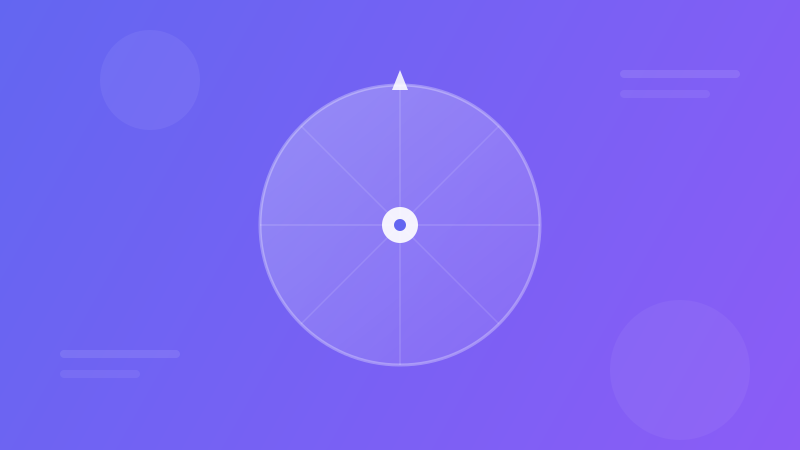
Spin the Wheel Widget: The Conversion Playbook
A practical, data-backed guide to building spin-the-wheel campaigns that convert without hurting your brand.
Spin wheels can feel gimmicky or premium depending on how you design them. The difference is the strategy, not the widget.
Why spin wheels outperform standard popups
A standard popup asks for an email in exchange for a discount. A spin wheel does the same thing but wraps it in a moment of anticipation. That anticipation — the brief second between spinning and seeing the result — is what dramatically lifts conversion rates. The psychology at work is variable reward reinforcement, the same mechanism behind slot machines and social media feeds. When the outcome is uncertain, engagement spikes.
Across ecommerce and SaaS sites running gamified versus non-gamified capture widgets, spin wheels consistently outperform static popups by two to three percentage points on cold traffic and four to six points on warm traffic. The gap widens on mobile, where the physical spinning gesture creates a tactile sense of participation that a static form cannot replicate.
The reason most spin wheels underperform has nothing to do with the format — it is the execution. Cluttered wheels, poor reward design, aggressive timing, and broken follow-up flows all erode the natural advantage gamification provides. This guide covers how to get each of those factors right.
One important clarification before we go further: spin wheels work best as a lead capture mechanism, not a discount engine. The goal is to capture an email or phone number that you can follow up with. The wheel reward is the incentive to submit the form, not the main event. Teams that confuse these two things end up giving away margin without building a list.
- Spin wheels convert 4–9% on cold traffic vs. 2–5% for standard popups
- The variable reward mechanism increases interaction time by 2–4 seconds on average
- Mobile conversion advantage is largest on gamified widgets due to gesture interaction
- Best used as a lead capture tool, not just a discount delivery mechanism
Designing a wheel that converts without looking cheap
The first design decision is segment count. Wheels with fewer than four segments feel rigged. Wheels with more than eight segments feel cluttered and make text unreadable on mobile. The sweet spot is five or six segments, which gives you enough variety to make the outcome feel uncertain while keeping the visual clean enough to be legible at any size.
Color contrast between segments matters more than most teams realise. Adjacent segments need to be visually distinct enough that the user can track the wheel as it spins. Using your brand's primary palette with one or two neutral segments is a reliable approach. Avoid more than three distinct hues — a chaotic colour wheel signals low quality before the visitor has read a single word.
Typography on wheel segments should be minimal. Three to four words per segment maximum. If your offer requires more explanation, put that context in the header copy above the wheel, not on the segment itself. The segment text is a label, not a description.
On mobile, test your wheel at 320px wide before launching. Many wheel implementations that look clean on desktop become unreadable when the canvas shrinks to phone dimensions. Font sizes below 11px on a mobile canvas are effectively invisible in motion.
- Use 5–6 segments — fewer feels rigged, more feels cluttered
- Ensure high contrast between adjacent segments (brand primary + 1–2 neutrals)
- Keep segment text to 3–4 words maximum
- Test at 320px mobile width before launch
- Maintain brand consistency in wheel border, button, and modal colours
The offer structure that protects your margin
The most common margin mistake with spin wheels is treating every segment as a guaranteed win. If every outcome is a discount of some kind, you are giving away margin on 100% of captures. A well-structured wheel uses reward tiering to maintain the excitement of a guaranteed outcome while controlling cost per acquired contact.
A reliable structure for ecommerce is: two mid-value outcomes (10–15% off), two low-value outcomes (free shipping or a small gift), one high-value outcome (25% off or a free product — weighted very low), and one or two 'try again' slots. The try-again slot is crucial. It maintains the feel of a real game while giving you a second capture opportunity on the next session.
The high-value prize slot should be weighted at 3–5% probability. Its purpose is not to drive volume — it is to make the wheel feel genuinely exciting. When visitors see '25% off' as a possible outcome, they engage. Most will land on a mid or low-value segment and still be satisfied because the form of the game felt fair.
For SaaS and service businesses, non-monetary rewards work well: a free trial extension, access to a premium template, a strategy guide download, or priority onboarding. These cost nothing to deliver but carry high perceived value when framed correctly.
- 2 mid-value segments (10–15% off) for volume
- 2 low-value segments (free shipping, small gift) for cost control
- 1 high-value segment (25%+ off) at 3–5% probability for excitement
- 1–2 try-again slots for re-engagement opportunity
- SaaS: use trial extensions, templates, or guides instead of discounts
Timing and targeting: when and where to show the wheel
A spin wheel shown the instant a visitor lands on your homepage will underperform every time. Cold traffic needs context before it is ready to engage with a gamified offer. The page and timing choice is the single most controllable variable in your conversion rate outside of the offer itself.
For ecommerce product pages, a scroll-depth trigger at 50–65% of the page is effective. At that point, the visitor has read the product description and is either building intent or preparing to leave. On collection or category pages, a 20-second time delay tends to outperform scroll depth because browsing behaviour is more horizontal.
Exit intent is powerful on high-intent pages — product detail pages and cart pages in particular — but it should trigger a specific, page-matched offer rather than a generic wheel. A visitor abandoning their cart should see an offer related to what is in the cart, not a generic 'spin to win' wheel that has no connection to their session.
Frequency capping is non-negotiable. A visitor who dismisses your wheel should not see it again on the same session. One impression per session is the standard. One impression per 14 days per device is a reasonable longer-term cap. Repeat impressions without captures damage trust and inflate your impression count without improving results.
- Product pages: 50–65% scroll depth trigger performs best
- Category/collection pages: 20-second time delay
- Cart pages: exit intent with cart-matched offer
- Cap at 1 impression per session, 1 per 14 days per device
- Never trigger on the homepage for first-time visitors
Email capture and follow-up: what happens after the spin
The capture form should appear after the wheel reveals the result, not before. Asking for an email before the reveal creates friction and drops completion rates. The psychological sequence that works is: spin → reveal → 'Enter your email to claim your reward.' The reward disclosure creates the motivation for the form submission.
Keep the form to a single field for cold traffic: email only. Adding a name field at this stage reduces completions by 15–25% on average. If you need a phone number for SMS follow-up, ask for it in a second step after the email is captured, or in the first email of your welcome sequence.
The moment a contact is captured, the follow-up sequence should start. Sending the reward code immediately via email is both expected and effective — it confirms the address is real and delivers on the promise made during the wheel interaction. A welcome sequence starting within the first hour of capture consistently outperforms sequences that begin days later.
If you are using Visisto, the contact flows automatically into your email sequence as soon as the form is submitted. You do not need Zapier to connect your wheel captures to Mailchimp, Klaviyo, or HubSpot — the integration is native. Set up your welcome sequence once and every capture triggers it automatically, including the reward code delivery.
- Show the form after the reward is revealed, never before
- Single email field only for cold traffic — add name in follow-up
- Send the reward code in the first email, within minutes of capture
- Start a welcome sequence within the first hour of capture
- Use native integrations to avoid Zapier and reduce delivery failures
Measuring performance and running your first A/B test
The three numbers that matter for a spin wheel campaign are: impression-to-interaction rate (what percentage of people who see the wheel click it), interaction-to-completion rate (what percentage who click actually submit the form), and email delivery success rate (what percentage of captures successfully reach your email platform). Each of these can be improved independently.
A healthy impression-to-interaction rate is 35–55%. If you are below 35%, the problem is almost always the offer or the timing — the wheel is appearing at the wrong moment or the reward is not compelling enough. A healthy interaction-to-completion rate is 60–75%. Below that, the form is the issue: too many fields, confusing copy, or a broken reward reveal.
For your first A/B test, change the headline copy before experimenting with anything else. Copy is the highest-leverage variable and the fastest to test. Run a clean two-variant test — original vs. one change — with at least 200 impressions per variant before drawing conclusions. Statistical significance at 95% confidence is the minimum threshold worth acting on.
Conversion rate benchmarks for context: a spin wheel on a mid-traffic ecommerce site capturing cold traffic should realistically achieve 5–8% contact capture rate within the first 30 days with a well-structured offer and good targeting. Rates above 12% on cold traffic typically indicate warm or returning traffic is being included in the measurement.
- Track: impression-to-interaction, interaction-to-completion, delivery success rate
- Impression-to-interaction below 35%: fix the offer or timing
- Interaction-to-completion below 60%: fix the form or reward reveal
- First A/B test: change headline copy only, run for 200+ impressions per variant
- Cold traffic benchmark: 5–8% capture rate within first 30 days
Ready to put this into practice?
Launch a conversion widget and start capturing contacts in minutes.
Keep reading
View all →
High-Converting Popups Without Annoying Visitors
Design rules, timing logic, and copy patterns to get popup conversions without wrecking the experience.
Scratch Card Widgets: How to Make Them Feel Premium
Scratch cards can be high-end or tacky. This guide shows how to ship them like a premium experience.

Offer Widget Benchmarks (and What to Aim For)
A practical range of conversion benchmarks for wheels, popups, and scratch cards plus how to improve each.